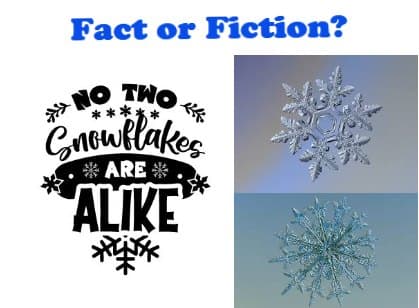
In 1988, scientist Nancy Knight was studying snow samples from a storm in Wausau, Wisconsin. Under a microscope, she found two snowflakes that were virtually identical — both hollow column crystals with matching structures.
The discovery made headlines worldwide and earned a Guinness World Record. Turns out, snowflakes can only form into about 35 distinct shapes
In 1988, scientist Nancy Knight was studying snow samples from a storm in Wausau, Wisconsin. Under a microscope, she found two snowflakes that were virtually identical — both hollow column crystals with matching structures.
The discovery made headlines worldwide and earned a Guinness World Record.
Turns out, snowflakes can only form into about 35 distinct shapes. While complex snowflakes are almost always unique, simpler crystal types can absolutely match.
In Short: "No two snowflakes are alike" → Myth. The proof? Found in Wisconsin.
More Science Facts
Snow Shoveling Kills About 100 Americans Every Year
Think shoveling your driveway is just a chore. It's actually one of the most dangerous activities you can do in winter
Ounce for ounce, Narwhal skin has the same amount of vitamin C as an Orange.
Having 20/20 vision means that you see an object at 20 feet with the clarity a “normal” eye sees it at 20 feet.
For instance, if you have 20/10 vision, you can see an object at 20 feet away with the clarity a “normal” eye sees it at 10 feet away. Conversely, if you have 20/100 vision, you see something at ...