← Back to all books
Brave New World
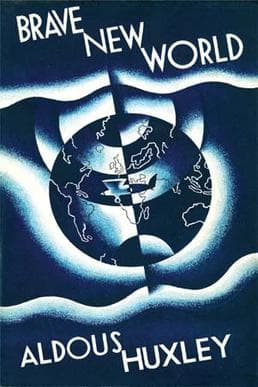
Brave New World Summary and Complete Study Guide
by Aldous Huxley
Published: 1932Science FictionModern Library #5
Complete Study Resources:
✓ Full plot summary
A dystopian future where people are genetically engineered, kept docile with drugs, and happiness is mandatory.
Complete Plot Summary
In this future, babies are grown in bottles and conditioned for specific castes (Alpha, Beta, Gamma, Delta, Epsilon). Everyone takes "soma" to stay happy and avoid negative emotions. Sex is casual and encouraged, but love and family are considered obscene. Bernard takes Lenina to a Savage Reservation in New Mexico, where they meet John, who was born naturally to a woman from the World State. Bernard brings John back to London as a curiosity, but John is horrified by the shallow, pleasure-focused society.
Main Characters in Brave New World
Brave New World features complex characters representing different aspects of society and the human condition.
**John the Savage**: Raised on the Reservation reading Shakespeare, John enters the World State with romantic ideals about love, honor, and meaning. His mother Linda came from the World State but got stranded on the Reservation pregnant, which horrified her—natural birth is obscene in her culture. John is caught between two worlds: too "civilized" for the Reservation (he's white, literate, different), too "savage" for the World State (he wants monogamy, believes in God, values art). His suicide isn't just depression—it's the impossibility of authentic existence in a world that's eliminated authenticity. He represents what humanity loses when we choose comfort over meaning.
**Bernard Marx**: The Alpha-Plus with an inferiority complex because he's physically smaller than other Alphas (possibly alcohol in his blood surrogate during bottle-growth). He questions the system not from principles but from resentment at not fitting in. When bringing John back makes him popular, Bernard becomes insufferable, proving he wanted status, not actual change. Huxley is showing that outsiders don't automatically become heroes—sometimes they just want to be accepted by the system they criticize.
**Lenina Crowne**: The perfect World State citizen who genuinely doesn't understand John's objections to casual sex. She likes him and offers herself, confused when he calls her a whore. She takes soma whenever uncomfortable feelings arise. She's not evil or stupid—she's fully socialized into this world. Her inability to comprehend John's perspective shows how complete the conditioning is. She represents people who are happy in oppressive systems because they don't know alternatives exist.
**Mustapha Mond**: The World Controller who's read Shakespeare and understands exactly what was sacrificed for stability. Unlike Napoleon in Animal Farm who's just power-hungry, Mond genuinely believes the World State is better than the alternative. He's read history—the wars, famines, diseases—and thinks eliminating human suffering justifies eliminating human freedom. His debate with John is the book's philosophical core: is happiness without freedom worth it? Mond says yes, knowing full well what that costs.
Major Themes in Brave New World
**Major Themes**: Happiness vs. Freedom - The World State eliminated war, disease, old age, and sadness. People are content. But they're also controlled, shallow, and identical. Huxley asks: would you trade freedom for guaranteed happiness? Most people would say no, but would you really? The book suggests most humans would choose soma over struggle. Technology as Control - Unlike Orwell's boot stamping on a face, Huxley's control is pleasurable. Genetic engineering, conditioning, drugs—all remove the need for force. People police themselves. Modern parallels: social media algorithms, pharmaceutical solutions to unhappiness, entertainment as distraction. Consumer Culture Critique - "Ending is better than mending"—buy new instead of fixing old. Economic stability requires constant consumption. People are conditioned to hate nature because it's free. The World State needs people buying things to maintain order. Written in 1932, it predicted consumer culture's dominance. Art and Science Sacrificed - Shakespeare is banned for being too emotional. Scientific inquiry is restricted to approved topics. Religion is replaced with Ford worship (mass production as deity). Huxley values intellectual and artistic freedom above physical comfort, asking what life is worth without them.
The Ending Explained
John falls for Lenina but can't reconcile his romantic ideals with her casual approach to sex. He causes a riot by throwing away soma rations, trying to free people from drug-induced happiness. Mustapha Mond explains that the World State chose stability and happiness over truth and beauty—art, science, and religion were sacrificed for a society without war or suffering. John retreats to a lighthouse to live alone, but crowds harass him. When Lenina visits, he whips her and himself in a frenzy. A mob forms to watch. The next day, John hangs himself. The lesson? A society that eliminates all pain and struggle also eliminates what makes us human. Happiness without freedom, art, or authentic emotion isn't happiness at all—it's comfortable slavery.
Famous Quotes from Brave New World
“Community, Identity, Stability.”
“Ending is better than mending.”
“A gramme is better than a damn.”
Why This Book Matters
Published in 1932, Huxley's dystopia predicted pharmaceutical control, consumer culture, and entertainment as oppression with eerie accuracy. The book has sold over 15 million copies and is taught alongside 1984 as essential dystopian literature. While Orwell feared government force, Huxley feared we'd willingly give up freedom for pleasure—arguably more prescient. The novel influenced science fiction and continues to be cited in debates about genetic engineering, drug culture, and technological control.
Ready to Dive Deeper?
Explore detailed analysis, essay examples, and study tools: