← Back to all books
Frankenstein
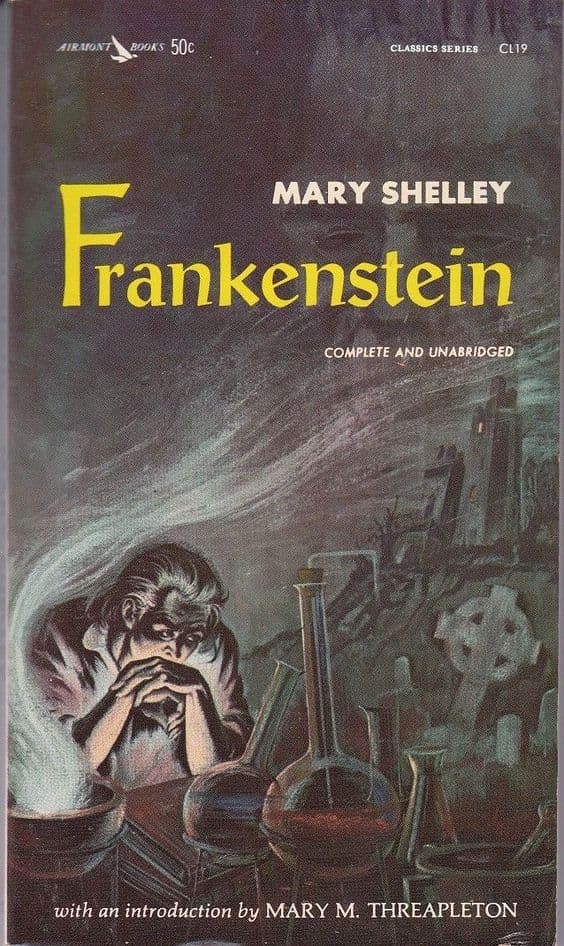
Frankenstein Summary and Complete Study Guide
by Mary Shelley
Published: 1818HorrorFirst Sci-Fi Novel
Complete Study Resources:
✓ Full plot summary
A scientist creates life, then abandons his creation, leading to a tragic tale of rejection, revenge, and responsibility.
Complete Plot Summary
Victor Frankenstein becomes obsessed with creating life and succeeds in animating a creature from dead body parts. But the Creature is ugly, so Victor runs away in horror, abandoning his creation. The Creature educates himself, learns language, and desperately seeks acceptance but gets attacked everywhere he goes. He saves a girl from drowning and gets shot for his trouble. Rejected by humanity, the Creature finds Victor and demands he create a female companion. Victor starts building one but destroys her, fearing they'll create a race of monsters. Big mistake.
Main Characters in Frankenstein
Frankenstein features complex characters representing different aspects of society and the human condition.
**Victor Frankenstein**: The ambitious young scientist obsessed with creating life. Mary Shelley makes his flaw clear: he loves the theory of creation but is repulsed by the reality. The moment the Creature opens his eyes, Victor runs away like a deadbeat dad. He gets sick, recovers, and just... doesn't go back. He abandons his creation to figure out the world alone. Later, when the Creature finds him and asks for basic compassion, Victor starts creating a mate then destroys her out of fear. Every choice Victor makes is about avoiding responsibility. He's brilliant but selfish, pioneering but cowardly. His pursuit of the Creature across the Arctic is revenge, not justice—he's still not taking responsibility, just blaming his creation for consequences he caused.
**The Creature**: Most sympathetic "monster" in literature. He wakes up confused in Victor's lab, gets abandoned, and teaches himself to read using Paradise Lost, Plutarch's Lives, and The Sorrows of Young Werther (very specific taste for someone who found random books). He saves a girl from drowning and gets shot. He helps a family by cutting wood anonymously, then reveals himself and they beat him with sticks. Every attempt at kindness gets punished because he's ugly. His request for a companion is reasonable—just make someone who won't reject me. Victor's refusal to create a mate is what transforms the Creature from rejected victim into murderer. He kills not from evil nature but from learned hatred after a lifetime of rejection. His eloquence in the book contradicts the popular image of a grunting monster. He out-argues Victor philosophically.
**Robert Walton**: The frame narrator whose Arctic exploration mirrors Victor's ambition. His letters to his sister frame the story. He rescues Victor and hears his warning about dangerous ambition, then actually listens and turns his ship around—he's the only character who learns before tragedy strikes. His presence suggests the story's message is meant for ambitious people specifically: know when to stop.
**Elizabeth Lavenza**: Victor's adopted sister/fiancée (yes, it's weird). She's good, patient, and waits for Victor while he vanishes for years doing science stuff. She represents what Victor destroys through his obsession—family, love, normalcy. Her death on their wedding night is the Creature punishing Victor by making him as alone as the Creature is. She's underdeveloped as a character, which might be Mary Shelley showing how Victor sees women: as beautiful objects, not full people.
Major Themes in Frankenstein
**Who's the Real Monster?**: The central question. The Creature kills multiple people—definitely monstrous acts. But Victor created life and abandoned it, then refused to create a companion, forcing the Creature into isolation. Victor's intellectual curiosity didn't include ethical responsibility. Mary Shelley (writing at 18!) asks whether scientific advancement without moral consideration creates horrors. The Creature says: "I was benevolent and good; misery made me a fiend." Society creates monsters by rejecting difference.
The Ending Explained
Enraged by Victor's refusal and destruction of his potential mate, the Creature kills everyone Victor loves—his best friend Henry, his bride Elizabeth on their wedding night, even his father dies of grief. Victor chases the Creature to the Arctic, determined to destroy his creation. Victor dies on Walton's ship, still pursuing revenge. The Creature appears, genuinely mourning Victor, then vanishes into the Arctic to die alone. The real horror isn't the Creature—it's Victor's abandonment of responsibility. Mary Shelley asks: who's the real monster? The one who kills out of pain and rejection, or the creator who abandons his creation? It's about parental responsibility, the dangers of playing God, and how society creates monsters through cruelty and rejection.
Famous Quotes from Frankenstein
“Beware; for I am fearless, and therefore powerful.”
Why This Book Matters
Written by Mary Shelley at age 18 and published in 1818. Considered the first science fiction novel. Has influenced countless adaptations and remains culturally relevant for discussions about scientific ethics, artificial intelligence, and creator responsibility.
Ready to Dive Deeper?
Explore detailed analysis, essay examples, and study tools: