← Back to all books
The Grapes of Wrath
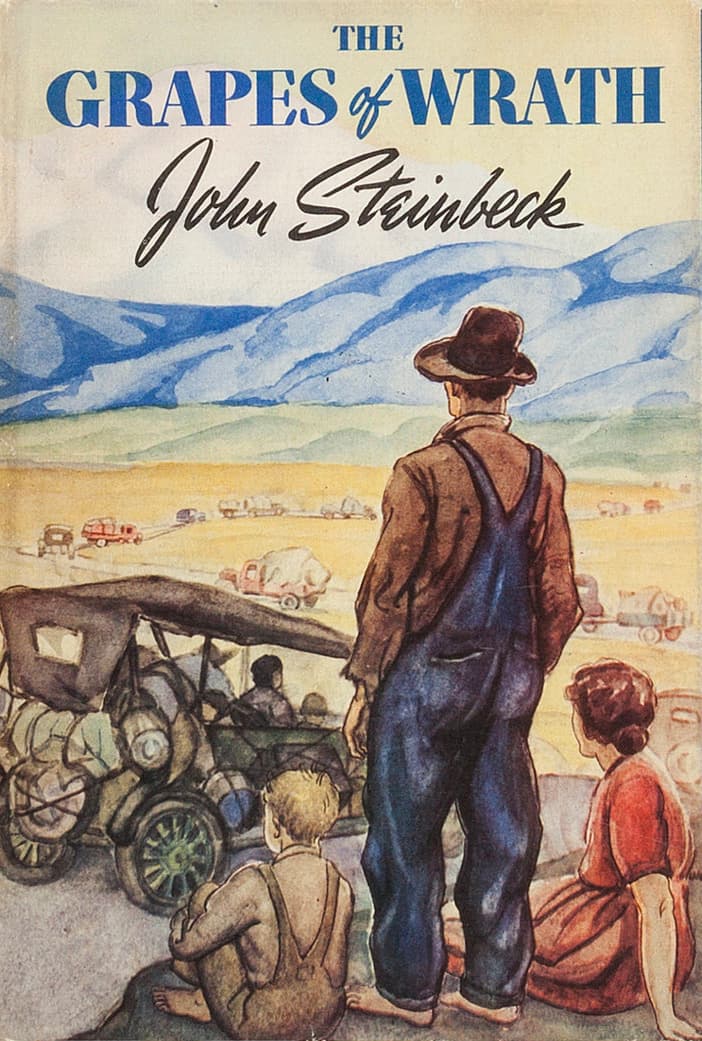
The Grapes of Wrath Summary and Complete Study Guide
by John Steinbeck
Published: 1939Historical FictionPulitzer Prize 1940
Complete Study Resources:
✓ Full plot summary
The Joad family joins thousands fleeing the Dust Bowl for California, only to find exploitation and broken promises.
Complete Plot Summary
Dust Bowl devastation forces the Joads and thousands of other families to abandon their farms and head to California, lured by handbills promising work picking fruit. The journey is brutal—family members die along the way, including the grandparents. When they finally reach California, they discover the jobs are scarce, the pay is terrible, and there are way too many desperate people competing for work. The handbills were a trick to flood the labor market and drive down wages. They bounce between migrant camps, facing hostility from locals who call them "Okies" and treat them like trash.
Main Characters in The Grapes of Wrath
The Grapes of Wrath features complex characters representing different aspects of society and the human condition.
**Ma Joad**: The family's backbone who refuses to let them break apart even when everything's falling apart. She slaps Rose of Sharon when she whines, not out of cruelty but because survival requires toughness. Her famous line about women being like a stream that flows around rocks while men are like boulders that break—that's Steinbeck showing who really holds families together during crisis. She's not sentimental; she's practical and fierce. When Grampa dies, she doesn't have time to grieve—there's too much to do. By the end, when she helps Rose of Sharon feed the starving man, she's still making decisions about survival and dignity.
**Tom Joad**: Fresh out of prison for killing a guy in a fight, Tom starts out just wanting to keep his head down and not go back to jail. He's not political at first—he just wants to help his family survive. But watching corporate goons beat up workers, seeing cops break up camps, watching Casy get killed for organizing—it radicalizes him. His transformation from looking out for himself to joining the labor movement is gradual and earned. That famous speech ("Wherever they's a fight...") isn't abstract idealism; it comes from witnessing specific injustices. He becomes the people's champion not because he read Marx but because he saw children starving while fruit rotted in orchards to keep prices high.
**Jim Casy**: The preacher who lost his faith in religion but found it in people. His initials (J.C.) aren't subtle—he's a Christ figure who dies for organizing workers. But he's not perfect; he admits to "sinning" with parishioners, questions everything, curses. He represents spiritual seeking outside organized religion. His idea that all souls are part of one big soul becomes the book's philosophy—we're all connected, so injustice anywhere threatens everyone. When he's murdered for trying to help workers, his death galvanizes Tom. Steinbeck showing that martyrs create movements.
**Rose of Sharon**: Starts as a naive pregnant girl dreaming about her baby's future. She loses the baby, loses her husband who abandons her, loses everything. That final scene—feeding a stranger with the milk meant for her dead child—transforms her from victim to agent of grace. Some readers find it too symbolic, but Steinbeck isn't being subtle because subtlety felt wrong for the stakes. She gives what she has left when she has nothing. That's the book's thesis: regular people practicing radical empathy might be our only hope against systemic cruelty.
Major Themes in The Grapes of Wrath
**Corporate Greed vs. Human Solidarity**: The villains aren't individuals; they're banks, corporations, and the system itself. Nobody specifically decided to starve the Joads—it's just how capitalism works when profit is the only motive. Landowners would rather let fruit rot than lower prices. Banks would rather evict families than risk bad debt. The orange grove scene where guards prevent starving people from picking rotting oranges—that image haunted readers in 1939 and still stings. Steinbeck's solution? Collective action. Individual families can't fight the system, but organized workers might have a chance.
The Ending Explained
The family ends up in a flooded boxcar with no food and a sick man dying nearby. Rose of Sharon just gave birth to a stillborn baby. In one of literature's most controversial and powerful moments, she breastfeeds the starving man to keep him alive. Steinbeck's message isn't subtle: corporate greed destroys lives, but human compassion and dignity persist even in the worst conditions. The book shows how capitalism without regulation can crush the vulnerable, how desperate people will exploit other desperate people, and how family and community become everything when the system fails you. It's rage and empathy mixed together, showing both the worst and best of humanity.
Famous Quotes from The Grapes of Wrath
“Wherever they's a fight so hungry people can eat, I'll be there.”
“A fella ain't got a soul of his own, just a little piece of a big soul, the one big soul that belongs to everybody.”
“How can you frighten a man whose hunger is not only in his own cramped stomach but in the wretched bellies of his children?”
Why This Book Matters
Published in 1939, won the Pulitzer Prize. Steinbeck won the Nobel Prize in Literature in 1962. The novel has sold over 15 million copies and remains essential reading about the Great Depression, corporate exploitation, and family resilience.
Ready to Dive Deeper?
Explore detailed analysis, essay examples, and study tools: