1984 Summary and Complete Study Guide
Complete Study Resources:
In a totalitarian future where Big Brother watches everything and the Thought Police punish dissent, one man dares to think forbidden thoughts, love secretly, and search for truth—only to discover that the Party's power over reality is absolute.
What is 1984 About? (Quick Summary)
Quick Answer: 1984 is George Orwell's 1949 dystopian novel about Winston Smith, a man living in totalitarian Oceania where the Party, led by Big Brother, controls every aspect of life through constant surveillance, propaganda, and thought control. Winston works rewriting history at the Ministry of Truth but secretly rebels by starting a diary and having an affair. He's captured, tortured, and psychologically destroyed until he genuinely loves Big Brother. The novel warns against totalitarianism, surveillance states, and the manipulation of truth and language.
Frequently Asked Questions
What is 1984 about?
1984 is set in a totalitarian future where the Party, led by Big Brother, controls every aspect of life in Oceania. Winston Smith, a low-ranking Party member, secretly rebels by keeping a diary, having a forbidden love affair with Julia, and seeking out an underground resistance. He's caught by the Thought Police, tortured into submission by O'Brien, and ultimately broken so completely that he genuinely learns to love Big Brother. The novel is a warning about totalitarianism, propaganda, and the manipulation of truth.
Who is Big Brother in 1984?
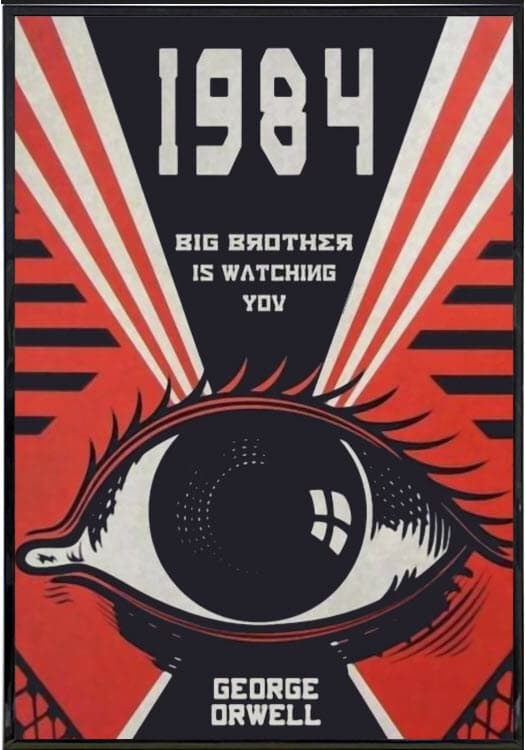
Big Brother is the supreme leader of the Party and the face of Oceania's totalitarian government. His image appears on posters everywhere with the slogan 'Big Brother Is Watching You.' Whether Big Brother actually exists as a real person is deliberately ambiguous—he may be a figurehead invented by the Party to personify its power. O'Brien tells Winston that Big Brother will never die because the Party is immortal. Big Brother represents the cult of personality that totalitarian regimes use to consolidate power and demand absolute loyalty.
What is Newspeak in 1984?
Newspeak is the official language of Oceania, designed by the Party to limit the range of thought. By systematically eliminating words and simplifying grammar, the Party aims to make it literally impossible to think rebellious thoughts—if there's no word for 'freedom,' the concept itself becomes unthinkable. The appendix describes Newspeak's goal as narrowing thought to the point where orthodoxy becomes automatic. It's Orwell's exploration of the Sapir-Whorf hypothesis: that language shapes and limits thought.
What does Room 101 represent?
Room 101 is the torture chamber in the Ministry of Love where prisoners face their worst personal fear. For Winston, it's rats. The room represents the breaking point of individual resistance—the moment when pain and terror override all principles, loyalties, and love. When Winston screams 'Do it to Julia!' he doesn't just submit to the Party; he actively betrays the person he loves most. Room 101 proves that the Party can reach into the deepest core of human identity and destroy it. The name reportedly came from a meeting room at the BBC that Orwell particularly disliked.
Is 1984 based on real events?
Orwell drew heavily from real totalitarian regimes. The Party's propaganda mirrors Stalin's Soviet Union, where photographs were doctored and history constantly rewritten. The Two Minutes Hate parallels Nazi rallies. The telescreens echo wartime surveillance. Winston's job rewriting history at the Ministry of Truth was inspired by Orwell's own work at the BBC during WWII, where he witnessed government propaganda firsthand. Orwell fought in the Spanish Civil War and saw how the Stalinist faction falsified events he personally witnessed, an experience that profoundly shaped his distrust of ideological authority.
What is the main message of 1984?
Orwell's central warning is that totalitarianism doesn't just control behavior—it controls reality itself. The Party's slogan 'Who controls the past controls the future; who controls the present controls the past' captures this: by manipulating historical records and language, a regime can make its citizens unable to recognize or resist oppression. The novel argues that truth is fragile, that propaganda can override personal experience, and that without the freedom to say 'two plus two equals four,' all other freedoms are meaningless. It remains a warning about surveillance, propaganda, and the erosion of objective truth.
Complete Plot Summary
Main Characters in 1984
1984 features complex characters representing different aspects of society and the human condition.
Winston Smith
A 39-year-old Outer Party member who works at the Ministry of Truth, Winston is defined by his ability to remember a time before the Party's total control—or at least to suspect that such a time existed.
Read full analysis →O'Brien
An Inner Party member who poses as a Brotherhood sympathizer to trap Winston. O'Brien is intelligent, articulate, and terrifying in his complete devotion to the Party's philosophy of power.
Read full analysis →Julia
A 26-year-old Outer Party member who works in the Fiction Department. Julia's rebellion is physical and personal rather than intellectual—she breaks Party rules not to overthrow the system but to live freely within it.
Read full analysis →Major Themes in 1984
Totalitarian Control
Orwell's most radical insight is that totalitarian power doesn't need a purpose beyond itself. O'Brien explicitly states this: 'The object of power is power.' Unlike Marxist ideology (which promises a workers' paradise) or fascism (which promises national glory), the Party in 1984 has abandoned all pretense of serving a greater good. They want power because power is power, and they exercise it through control of reality itself.
Surveillance and the Death of Privacy
The telescreen—a two-way device that both broadcasts propaganda and watches citizens—is Orwell's most prescient invention. In 1949, the technology seemed fantastical. Today, we carry telescreens voluntarily in our pockets. The parallel between Orwell's surveillance state and modern digital surveillance is striking, though the mechanisms differ. In 1984, surveillance is imposed by the state; today, citizens voluntarily share information that would have required the Thought Police to extract by force.
The Ending Explained
Famous Quotes from 1984
“Big Brother is watching you.”
“War is peace. Freedom is slavery. Ignorance is strength.”
“Who controls the past controls the future. Who controls the present controls the past.”
“If you want a picture of the future, imagine a boot stamping on a human face—forever.”
“Freedom is the freedom to say that two plus two make four. If that is granted, all else follows.”
Why This Book Matters
Ready to Dive Deeper?
Explore detailed analysis, essay examples, and study tools:
Character Analysis
Deep dive into all major characters with detailed analysis and symbolism.
Read more →Themes & Symbols
Explore major themes and symbolic elements throughout the novel.
Read more →Chapter Summaries
Complete breakdown of all chapters with key events and analysis.
Read more →Essay Examples
5 complete essay examples with prompts, thesis statements, and full samples.
Read more →Study Tools: Quiz & Flashcards
Test your knowledge with 50 flashcards and 20 quiz questions.
Start studying →About George Orwell
Learn about the author's life, writing style, and legacy.
Read biography →