Animal Farm
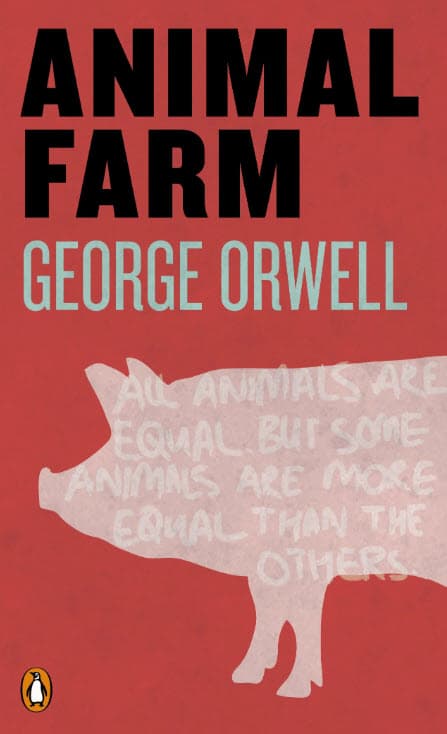
Animal Farm Summary and Complete Study Guide
Complete Study Resources:
When the animals of Manor Farm overthrow their drunken master and seize control, they dream of building a society where all creatures are equal. But as the pigs consolidate power through propaganda, fear, and rewritten commandments, the dream of liberation curdles into a new and more insidious tyranny.
What is Animal Farm About? (Quick Summary)
Quick Answer: Animal Farm is George Orwell's 1945 allegorical novella about farm animals who rebel against their human farmer, hoping to create equality. The pigs, led by Napoleon, gradually become corrupt dictators, demonstrating how "All animals are equal, but some animals are more equal than others." It's an allegory for the Russian Revolution and Stalin's rise to power.
Frequently Asked Questions
What is Animal Farm about?
Animal Farm tells the story of farm animals who rebel against their human owner, Mr. Jones, hoping to create a society where all animals are free and equal. The pigs, led by Napoleon, take charge of the new government but gradually become as corrupt and oppressive as the humans they overthrew. Through propaganda, violence, and the systematic rewriting of their founding principles, the pigs transform into the very tyrants the revolution was meant to destroy. It is an allegory for the Russian Revolution and Stalin's betrayal of communist ideals.
Is Animal Farm based on real events?
Yes, Animal Farm is a direct allegory of the Russian Revolution of 1917 and the rise of Joseph Stalin's Soviet Union. Old Major represents Karl Marx and Vladimir Lenin, whose ideas inspired the revolution. Napoleon represents Stalin, who seized power through force and propaganda. Snowball represents Leon Trotsky, the idealist expelled and scapegoated by Stalin. The Battle of the Cowshed parallels the Russian Civil War, the windmill represents Stalin's Five-Year Plans, and the purges mirror Stalin's show trials and mass executions of the 1930s. Orwell drew on his firsthand experience of Stalinist tactics during the Spanish Civil War.
Who does Napoleon represent?
Napoleon represents Joseph Stalin, the Soviet dictator who rose to power after Lenin's death. Like Stalin, Napoleon is not the most eloquent or intellectual leader—that role belongs to Snowball (Trotsky)—but he is the most cunning and ruthless. He consolidates power by secretly training dogs as his personal enforcers (representing the secret police), uses Squealer's propaganda to control information, eliminates rivals, conducts show trials and executions, rewrites history to suit his narrative, and builds a cult of personality. By the novel's end, Napoleon has become indistinguishable from the human oppressors.
What do the Seven Commandments symbolize?
The Seven Commandments symbolize the founding principles and constitutional documents of a revolution—ideals like equality, justice, and freedom that a new society is built upon. Their gradual corruption represents how those in power manipulate language and rewrite laws to serve their own interests while maintaining the appearance of legitimacy. Each alteration—adding 'with sheets,' 'to excess,' 'without cause'—shows how qualifiers can hollow out absolute principles. The final reduction to 'All animals are equal, but some animals are more equal than others' demonstrates the complete destruction of revolutionary ideals through linguistic contradiction.
Why is Animal Farm still relevant?
Animal Farm remains relevant because the patterns it describes—leaders using propaganda to control populations, rewriting history to suit their narrative, consolidating power through fear, and betraying the ideals they claim to represent—recur throughout history and across political systems. The novel is not merely about Soviet Russia; it is about the universal tendency of power to corrupt. Every generation encounters leaders who promise liberation and deliver oppression, who manipulate language to disguise their actions, and who exploit loyal citizens like Boxer. Orwell's warning applies wherever authoritarian tendencies emerge, making it timeless political commentary.
What is the moral of Animal Farm?
The central moral of Animal Farm is that power corrupts, and unchecked power corrupts absolutely. Orwell demonstrates that revolutions, no matter how idealistic their origins, can be hijacked by those who seek power for its own sake. The novel warns against blind loyalty, the dangers of an uneducated populace that cannot critically evaluate propaganda, and the ease with which founding principles can be eroded when citizens fail to remain vigilant. It also shows that simply replacing one set of rulers with another, without creating structures to prevent the concentration of power, guarantees the cycle of oppression will repeat.
Complete Plot Summary
Main Characters in Animal Farm
Animal Farm features complex characters representing different aspects of society and the human condition.
Napoleon
A large, fierce-looking Berkshire boar who becomes Animal Farm's supreme leader. Napoleon is not eloquent or intellectually creative, but he is cunning, ruthless, and singularly focused on acquiring and maintaining power.
Read full analysis →Snowball
A young, vivacious, inventive pig who genuinely believes in Animalism and works to improve the animals' lives through education, organization, and technology. He represents Leon Trotsky and the idealism that is crushed when a more ruthless leader seizes power.
Read full analysis →Boxer
An enormous carthorse nearly eighteen hands high, as strong as any two ordinary horses put together. Boxer represents the loyal, hardworking common people whose strength sustains the regime and whose blind trust in authority leads to their ultimate betrayal.
Read full analysis →Major Themes in Animal Farm
Power and Corruption
Animal Farm's central argument is that power corrupts not occasionally but inevitably, and that the corruption follows a predictable pattern. The pigs do not begin as tyrants. In the early days of the rebellion, they work alongside the other animals, contribute to the harvest, and appear genuinely committed to the principles of Animalism. But the first act of corruption—claiming the milk and apples for themselves—establishes a precedent. Once the pigs accept that their role as 'brain workers' entitles them to special privileges, every subsequent privilege follows logically. If pigs deserve better food because they manage the farm, why shouldn't they sleep in beds? If they sleep in beds, why not in the farmhouse? If they live in the farmhouse, why not drink the farmer's whiskey?
Propaganda and Language Control
If Napoleon's dogs represent the physical force behind the regime, Squealer represents its intellectual apparatus—the propaganda machine that makes brute force palatable or even invisible. Squealer's techniques are sophisticated and varied. He uses fear, asking 'Surely you don't want Jones back?' to frame any criticism of the pigs as support for the old regime. He uses false statistics, reading out production figures that contradict the animals' own experience of hunger. He redefines vocabulary, calling food reductions 'readjustments' to strip the word of its negative connotation. He exploits the animals' poor memory and limited literacy, insisting that commandments always said what they now say.
The Ending Explained
Famous Quotes from Animal Farm
“All animals are equal, but some animals are more equal than others.”
“The creatures outside looked from pig to man, and from man to pig, and from pig to man again; but already it was impossible to say which was which.”
“Man is the only creature that consumes without producing.”
“Four legs good, two legs bad.”
Why This Book Matters
Ready to Dive Deeper?
Explore detailed analysis, essay examples, and study tools:
Character Analysis
Deep dive into all major characters with detailed analysis and symbolism.
Read more →Themes & Symbols
Explore major themes and symbolic elements throughout the novel.
Read more →Chapter Summaries
Complete breakdown of all chapters with key events and analysis.
Read more →Essay Examples
5 complete essay examples with prompts, thesis statements, and full samples.
Read more →Study Tools: Quiz & Flashcards
Test your knowledge with 50 flashcards and 20 quiz questions.
Start studying →About George Orwell
Learn about the author's life, writing style, and legacy.
Read biography →