About Fyodor Dostoevsky
Russian master of psychological realism and existential philosophy
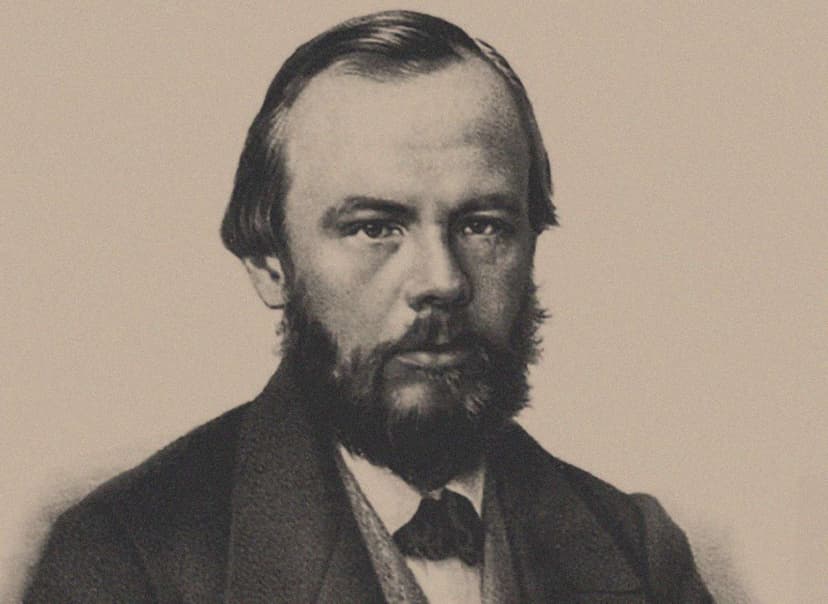
Quick Facts:
- Born:
- Moscow, Russia
- Died:
- St. Petersburg, Russia (age 59)
- Education:
- Military Engineering Academy
- Famous For:
- Psychological realism, existential philosophy
- Major Works:
- Crime and Punishment, The Brothers Karamazov, Notes from Underground
- Key Experience:
- Mock execution and Siberian exile (1849-1859)
- Influence:
- Influenced Freud, Nietzsche, Camus, existentialism
Who Was Fyodor Dostoevsky?
Dostoevsky's Writing Style
Dostoevsky's style is intense, chaotic, and psychologically immersive. He uses stream-of-consciousness before Joyce, showing characters' minds racing, contradicting themselves, and breaking down in real time. His sentences are long and fevered, mirroring his characters' mental states. He doesn't describe psychology from outside; he puts you inside the consciousness experiencing it. This creates exhausting, brilliant reading—you feel Raskolnikov's fever, guilt, and paranoia because Dostoevsky makes you think like him. His dialogue is philosophical—characters debate ideas for pages—but never feels academic because the ideas have life-or-death stakes. His realism isn't about external details but internal truth.
Legacy and Impact
Dostoevsky revolutionized the novel by making psychology primary. Before him, novels focused on external events and social observation. He showed that internal consciousness could be as dramatic as action. Freud acknowledged Dostoevsky's understanding of the unconscious predated psychoanalysis. Existentialists (Sartre, Camus) saw him as founder of their movement—his characters confronting absurdity, creating meaning, choosing in crisis. His exploration of rationalism's limits, suffering's potential meaning, and the Superman concept influenced philosophy as much as literature. Crime and Punishment remains essential reading for understanding human psychology, moral philosophy, and the consequences of ideology divorced from humanity.
Other Works by Dostoevsky
The Brothers Karamazov (1880)
His final and longest novel, exploring faith, doubt, and morality through three brothers
Notes from Underground (1864)
Pioneering psychological novella about isolation and spite
The Idiot (1869)
Portrait of a "perfectly beautiful man" destroyed by society
Demons (1872)
Political novel about revolutionary nihilism in Russia