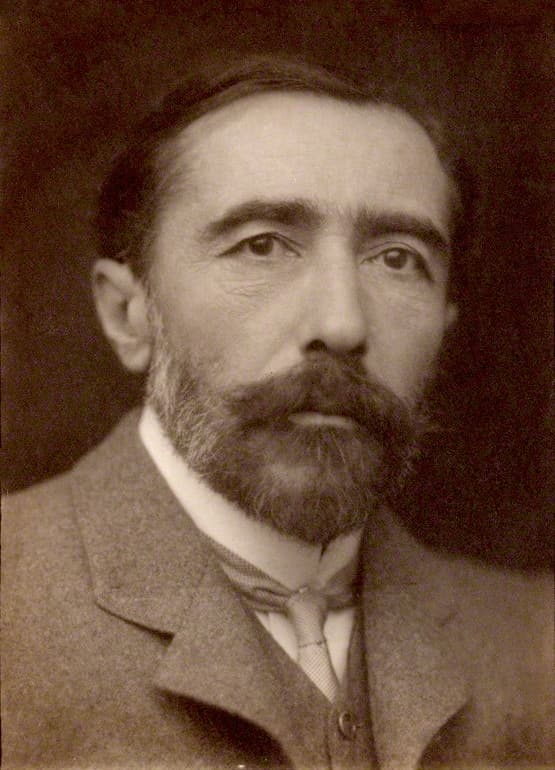
Joseph Conrad was born Józef Teodor Konrad Korzeniowski in 1857 in Russian-controlled Poland. His father was a poet and translator involved in Polish independence movements, which led to the family's exile to northern Russia. Both parents died from tuberculosis by the time Conrad was twelve, leaving him orphaned and in his uncle's care. These early experiences of political oppression, exile, loss, and displacement profoundly shaped his writing's themes of isolation, moral ambiguity, and the fragility of civilization.
At seventeen, Conrad went to sea with the French merchant marine, later joining the British merchant navy. He spent nearly twenty years as a sailor, eventually becoming a ship's captain. During this period, he learned English (his third language after Polish and French) and traveled to Southeast Asia, Africa, South America, and Australia. These voyages provided material for his fiction while giving him direct experience of European imperialism's operations.
In 1890, Conrad commanded a steamboat on the Congo River for the Belgian company exploiting what was then the Congo Free State under King Leopold II's brutal colonial regime. This experience—witnessing the horrific violence and exploitation of colonialism firsthand—became the basis for Heart of Darkness. Conrad was so disturbed by what he saw that he left Africa after only six months and never returned. The journey damaged his health permanently and convinced him that European imperialism was fundamentally barbaric despite its civilizing rhetoric.
Conrad began writing in the 1890s, publishing his first novel Almayer's Folly in 1895. He wrote in English, remarkable for someone who learned the language in his twenties. His prose style—dense, psychological, morally ambiguous—influenced modernist literature profoundly. Heart of Darkness, serialized in 1899 and published as book in 1902, became his most famous and controversial work.
The novel drew on Conrad's Congo experience but transformed autobiography into moral exploration of imperialism and civilization. It exposed Belgian colonial atrocities at a time when many Europeans still believed in the civilizing mission. Conrad's critique was brave and influential, shaping how subsequent generations understood colonialism's violence and hypocrisy.
However, Conrad's legacy is complicated. While he critiqued imperialism powerfully, his representation of Africa and Africans perpetuated racist stereotypes. Nigerian novelist Chinua Achebe famously condemned Conrad as "a thoroughgoing racist" whose novel reduces Africa to "the other world, the antithesis of Europe." This debate continues: Can we acknowledge Conrad's anti-imperialist message while critiquing his racist representations? Both are part of his legacy.
Conrad died in 1924, widely respected as literary master. His influence on 20th-century literature is immense—T.S. Eliot, F. Scott Fitzgerald, and countless others learned from his psychological depth, moral complexity, and modernist techniques. His work remains essential to understanding both literature and imperialism, though we read him more critically now, aware of both his courage in exposing colonial violence and his failure to imagine colonized peoples as fully human subjects rather than symbolic objects.