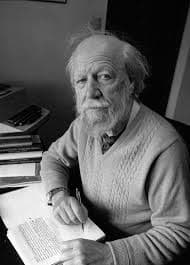
William Gerald Golding was born in Cornwall, England in 1911. His father was a schoolmaster, and Golding followed him into teaching, spending years working with boys at Bishop Wordsworth's School in Salisbury. This experience with adolescent male psychology and group dynamics directly influenced Lord of the Flies—he understood how boys form hierarchies, test authority, and respond to fear and freedom.
During World War II, Golding served in the Royal Navy from 1940-1945. He participated in the D-Day invasion of Normandy and the pursuit of the German battleship Bismarck. The war's horrors—witnessing humanity's capacity for organized violence, seeing educated Europeans commit genocide, participating in killing—profoundly shaped his pessimistic view of human nature. He later said the war taught him that humans are capable of terrible evil and that civilization's veneer is thinner than we want to believe.
Lord of the Flies, written in 1951-1952 and published in 1954, was initially rejected by numerous publishers who found it too dark and pessimistic. One rejection letter called it "an absurd and uninteresting fantasy which was rubbish and dull." But when it finally found a publisher, it became a massive success and has never gone out of print. Golding wrote it partly as response to R.M. Ballantyne's The Coral Island (1858), a Victorian boys' adventure story where British boys stranded on an island remained civilized and heroic. Golding's darker vision argued that British boys (or any boys) would quickly descend to savagery without adult supervision and social structures.
The novel became widely taught in schools by the 1960s, introducing generations of students to its pessimistic message about human nature. Golding won the Nobel Prize in Literature in 1983, with the committee noting his novels illuminate "the human condition in the world of today" with "the perspective of a cosmic myth." He continued writing until his death in 1993, but Lord of the Flies remained his most famous and influential work—selling over 25 million copies and spawning numerous film adaptations, stage productions, and cultural references.
His other novels explored similar dark themes: human capacity for evil, civilization's fragility, moral and spiritual crises. But none achieved Lord of the Flies' cultural penetration. The phrase "Lord of the Flies scenario" now describes any situation where social order collapses into chaos. The novel shaped how we think about human nature, childhood innocence (or lack thereof), and civilization's dependence on maintained structures rather than inherent human goodness.
Golding's legacy is this pessimistic but influential vision: humans are capable of terrible things, civilization is fragile achievement requiring constant work, and evil waits patiently beneath social constraints for opportunity to emerge. His WWII experience taught him that educated, civilized people can become monsters. Lord of the Flies teaches generations of readers the same lesson through stranded boys on an island. The beast is real. The beast is us. Civilization is the work of caging what we are. Stop the work, release the beast. That's Golding's warning, and that's why his novel, despite its darkness, remains essential reading.