About Fyodor García Márquez

Russian master of psychological realism and existential philosophy
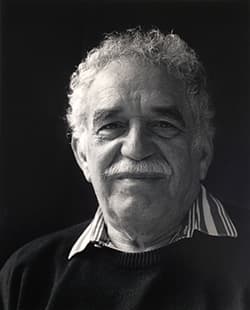
Gabriel García Márquez
1927-2014

Quick Facts:

Born:
Aracataca, Colombia
Died:
Mexico City, Mexico (age 87)
Education:
University of Bogotá (law, didn't complete)
Nobel Prize:
Literature, 1982
Famous For:
One Hundred Years of Solitude, Love in the Time of Cholera, magical realism
Key Influence:
Colombian history, grandmother's storytelling, journalism career
Political:
Socialist views, friend of Fidel Castro, critic of U.S. imperialism

Who Was Fyodor García Márquez?

Gabriel José de la Concordia García Márquez was born in 1927 in Aracataca, a small town in Colombia's Caribbean coast region. Raised primarily by his maternal grandparents until age eight, he credited his grandmother's storytelling style—narrating fantastical events with matter-of-fact delivery—as the foundation for his magical realism technique. She told stories where ghosts, miracles, and mundane events received identical narrative treatment because, in her worldview, all were equally real. This would become García Márquez's signature literary approach. After his grandfather's death, he returned to his parents and received formal education, eventually studying law at the National University of Colombia in Bogotá. But his real passion was writing and journalism. He dropped out of law school to pursue journalism full-time, working for Colombian newspapers and eventually becoming a foreign correspondent. His journalism career taught him concise prose, attention to political detail, and importance of documenting historical events authorities wanted forgotten—all skills serving his later fiction. His early writings struggled commercially. La hojarasca (Leaf Storm, 1955) and El coronel no tiene quien le escriba (No One Writes to the Colonel, 1961) were well-reviewed but didn't sell. He worked odd jobs, including advertising and film, while continuing to write. Living in Mexico City in the mid-1960s, he later said the entire structure of One Hundred Years of Solitude came to him suddenly while driving. He rushed home and spent 18 months writing obsessively, his wife Mercedes managing everything practical so he could focus entirely on the novel. One Hundred Years of Solitude was published in 1967 in Buenos Aires and became an unprecedented sensation. It sold out its first printing in days. Within years it had sold millions of copies and been translated into dozens of languages. García Márquez became internationally famous practically overnight. The novel put Latin American literature on the world stage and proved that non-European literary traditions could reshape global literature rather than merely imitating European models. He won the Nobel Prize in Literature in 1982, largely for One Hundred Years of Solitude, though his entire body of work was recognized. He continued writing acclaimed novels including Love in the Time of Cholera (1985), The General in His Labyrinth (1989), and Of Love and Other Demons (1994). He also wrote screenplays, short stories, journalism, and an autobiography, Living to Tell the Tale (2002). Politically, García Márquez was consistently leftist and anti-imperialist. He was friend and supporter of Fidel Castro (controversial relationship that complicated his reputation in some circles). He criticized U.S. intervention in Latin America and supported socialist movements, though he became more critical of specific communist implementations over time. His political views deeply informed his fiction—the banana company massacre in One Hundred Years reflects actual United Fruit Company history; the dictators in The Autumn of the Patriarch reflect real Latin American strongmen. He died in 2014 in Mexico City at age 87 from pneumonia, complications of dementia. World leaders attended his funeral. Colombia declared days of national mourning. He's considered one of the greatest writers of the 20th century and the defining figure of magical realism, leaving a legacy that permanently changed how literature represents reality.

García Márquez's Writing Style

García Márquez writes with deceptively simple, fluid prose that makes extraordinary events seem ordinary through tone. Long, flowing sentences with multiple clauses create dreamlike continuity. He treats magic and reality identically, never signaling which is which. Extensive detail about mundane acts (making coffee, sewing) receives same attention as fantastical events (ascending to heaven, four-year rains). Missing quotation marks blur dialogue into narration. Precise numbers (32 wars, 17 sons) make absurd things seem documented. Time jumps freely—sentence can span decades. Multiple characters share names intentionally creating confusion. His voice is his grandmother's: treating everything as equally true because all stories matter equally.

Legacy and Impact

García Márquez revolutionized world literature by creating and perfecting magical realism, proving Latin American narrative traditions could reshape global fiction rather than imitating European forms. One Hundred Years of Solitude influenced writers worldwide and established Latin American literature as major force. His work validated treating cultural folklore, myth, and magical thinking as legitimate literary techniques, not primitive superstition. He demonstrated that different historical and cultural experiences require different narrative forms—European realism wasn't universal default but one option among many. His Nobel Prize validated non-European narrative traditions. Terms like 'magical realism' and 'Márquezian' entered critical vocabulary. Writers from Salman Rushdie to Toni Morrison acknowledged his influence. He showed that the most accurate way to capture certain realities might be through the unreal, and that political critique can be embedded in apparent fantasy. His legacy: expanding what fiction can be and how it can tell truth.

Other Works by García Márquez

The Brothers Karamazov (1880)

His final and longest novel, exploring faith, doubt, and morality through three brothers

Notes from Underground (1864)

Pioneering psychological novella about isolation and spite

The Idiot (1869)

Portrait of a "perfectly beautiful man" destroyed by society

Demons (1872)

Political novel about revolutionary nihilism in Russia

Return to One Hundred Years of Solitude: