The Adventures of Huckleberry Finn
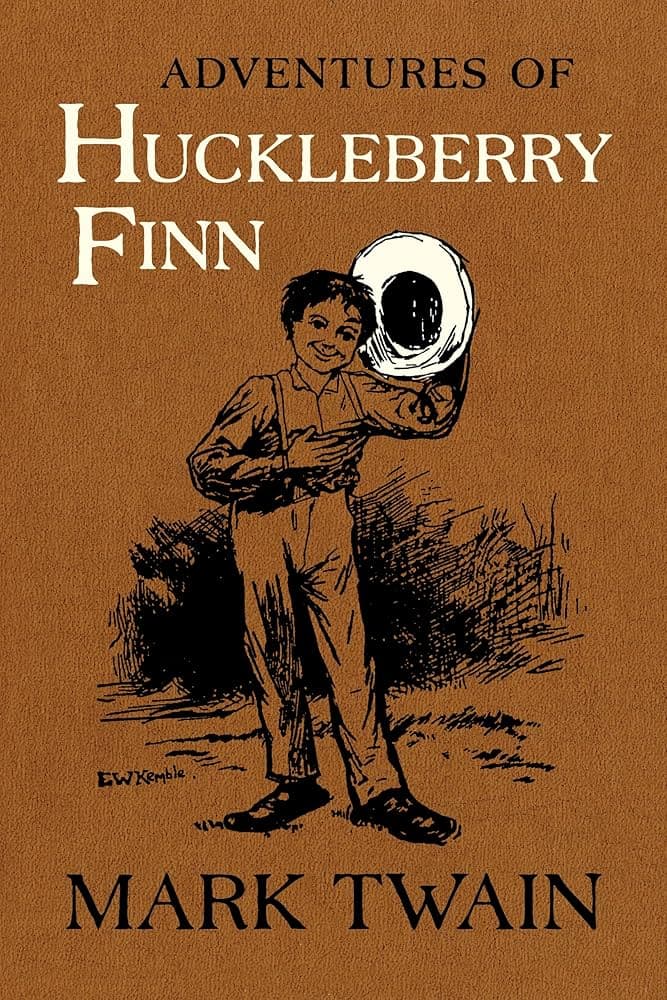
The Adventures of Huckleberry Finn Summary and Complete Study Guide
Complete Study Resources:
A runaway boy and an escaped slave float down the Mississippi River on a raft, encountering con artists, feuding families, and the moral contradictions of pre-Civil War America in Mark Twain's masterpiece of vernacular storytelling and social satire.
What is The Adventures of Huckleberry Finn About? (Quick Summary)
Quick Answer: Huckleberry Finn is Mark Twain's 1884 masterpiece about Huck, a boy escaping his abusive father, and Jim, an enslaved man seeking freedom. They travel down the Mississippi River encountering con artists, feuding families, and moral bankruptcy of pre-Civil War America. Huck's decision to 'go to hell' rather than betray Jim represents choosing conscience over society's corrupt teachings.
Frequently Asked Questions
What is The Adventures of Huckleberry Finn about?
The novel follows Huck Finn, a young boy who fakes his own death to escape his abusive father and teams up with Jim, an enslaved man fleeing to freedom. Together they travel down the Mississippi River on a raft, encountering con artists, feuding families, and the cruelty of pre-Civil War Southern society. Along the way, Huck wrestles with his conscience and ultimately rejects the racist morality of his society by choosing to help Jim, even though he believes doing so will damn him to hell.
Why is Huckleberry Finn controversial?
The novel has been controversial since its publication in 1885. It was initially banned for its coarse language and for depicting a white boy befriending an enslaved person. In modern times, the primary controversy centers on the racial slur that appears over two hundred times in the text. Defenders argue Twain used the word to expose the ugliness of racism through satire. Critics counter that the word causes real harm in classroom settings regardless of authorial intent, and that Jim is sometimes reduced to racial stereotypes, particularly in the final chapters.
What is the significance of the Mississippi River in Huckleberry Finn?
The Mississippi River functions as both the novel's physical setting and its central symbol. On the river, Huck and Jim experience genuine freedom—away from the rules, violence, and hypocrisy of shore-based civilization. The raft becomes a space where a white boy and a Black man can exist as equals, beyond the reach of slave laws and social hierarchy. However, the river also carries them deeper into slave territory, and its current is beyond their control, symbolizing the forces of fate and society that individuals cannot fully escape.
How does Huck's view of Jim change throughout the novel?
At the start, Huck sees Jim through the lens of his racist upbringing—as property rather than a person. Gradually, through shared experiences on the raft, Huck recognizes Jim's full humanity. He witnesses Jim's grief over his separated family, his loyalty, his generosity, and his moral integrity. The turning point comes when Huck decides to help Jim escape rather than turn him in, declaring he will 'go to hell.' This moral growth represents Huck's rejection of society's values in favor of his own natural compassion and sense of justice.
Is Huckleberry Finn a racist book?
This is American literature's most enduring debate. Supporters argue the novel is profoundly anti-racist: Twain uses irony and satire to expose slavery's moral bankruptcy, making Jim the most decent character while depicting white 'civilization' as violent and hypocritical. Huck's moral growth—choosing Jim's humanity over society's racism—is a powerful statement against racial oppression. Critics argue the frequent use of racial slurs, Jim's sometimes stereotypical portrayal, and the demeaning final chapters where Tom treats Jim's freedom as a game undermine the anti-racist reading. The answer likely depends on context, reader, and how the text is taught.
What is the moral of Huckleberry Finn?
The novel's central moral is that individual conscience must sometimes override the laws and customs of society. Huck's society teaches him that helping an enslaved person escape is sinful and criminal, yet his personal experience with Jim tells him that Jim is a good, loving human being who deserves freedom. When Huck chooses Jim over society, he demonstrates that true morality comes from empathy and personal experience rather than from inherited beliefs and institutional authority. The novel argues that a flawed society produces flawed morality, and that genuine moral courage means thinking for oneself.
Complete Plot Summary
Main Characters in The Adventures of Huckleberry Finn
The Adventures of Huckleberry Finn features complex characters representing different aspects of society and the human condition.
Huck Finn
A thirteen- or fourteen-year-old boy who narrates the novel in his own uneducated but perceptive vernacular voice. Huck is the son of the town drunk, raised outside polite society, and possesses an innate moral sense that ultimately proves superior to the 'civilized' morality of the slave-holding South.
Read full analysis →Jim
Miss Watson's enslaved man who runs away to avoid being sold down the river. Jim is the novel's most genuinely moral character—loyal, compassionate, self-sacrificing, and dignified—though his portrayal has been the subject of intense critical debate regarding racial stereotypes.
Read full analysis →Tom Sawyer
Huck's best friend and foil, Tom Sawyer is a respectable, well-read boy whose imagination is shaped entirely by adventure novels. He represents the romanticized, bookish worldview that the novel ultimately rejects in favor of Huck's direct moral engagement with reality.
Read full analysis →Major Themes in The Adventures of Huckleberry Finn
Individual Conscience vs. Social Morality
The central theme of Huckleberry Finn is the conflict between what society tells Huck is right and what his own heart knows to be true. Every institution in Huck's world—the church, the law, the school, the family—teaches him that slavery is morally legitimate and that helping an enslaved person escape is both a crime and a sin. Miss Watson, who represents Christian respectability, owns Jim. The Widow Douglas, who is genuinely kind, sees no contradiction between her faith and her slaveholding. The legal system treats Jim as property. The entire structure of Southern society is organized around the principle that Black people are not fully human.
Freedom vs. Civilization
Huckleberry Finn is structured around a fundamental opposition between life on the raft—free, egalitarian, honest—and life on the shore—violent, hierarchical, and hypocritical. Every time Huck and Jim land on shore, they encounter cruelty: Pap's drunken violence, the Grangerford-Shepherdson slaughter, the Duke and King's frauds, the lynch mob, the selling of enslaved people. Every time they return to the raft, they experience peace: quiet conversations under the stars, shared meals, genuine companionship uncorrupted by social roles.
The Ending Explained
Famous Quotes from The Adventures of Huckleberry Finn
“All right, then, I'll go to hell.”
“Persons attempting to find a motive in this narrative will be prosecuted; persons attempting to find a moral in it will be banished; persons attempting to find a plot in it will be shot.”
“It's lovely to live on a raft. We had the sky up there, all speckled with stars, and we used to lay on our backs and look up at them.”
Why This Book Matters
Ready to Dive Deeper?
Explore detailed analysis, essay examples, and study tools:
Character Analysis
Deep dive into all major characters with detailed analysis and symbolism.
Read more →Themes & Symbols
Explore major themes and symbolic elements throughout the novel.
Read more →Chapter Summaries
Complete breakdown of all chapters with key events and analysis.
Read more →Essay Examples
5 complete essay examples with prompts, thesis statements, and full samples.
Read more →Study Tools: Quiz & Flashcards
Test your knowledge with 50 flashcards and 20 quiz questions.
Start studying →About Mark Twain
Learn about the author's life, writing style, and legacy.
Read biography →